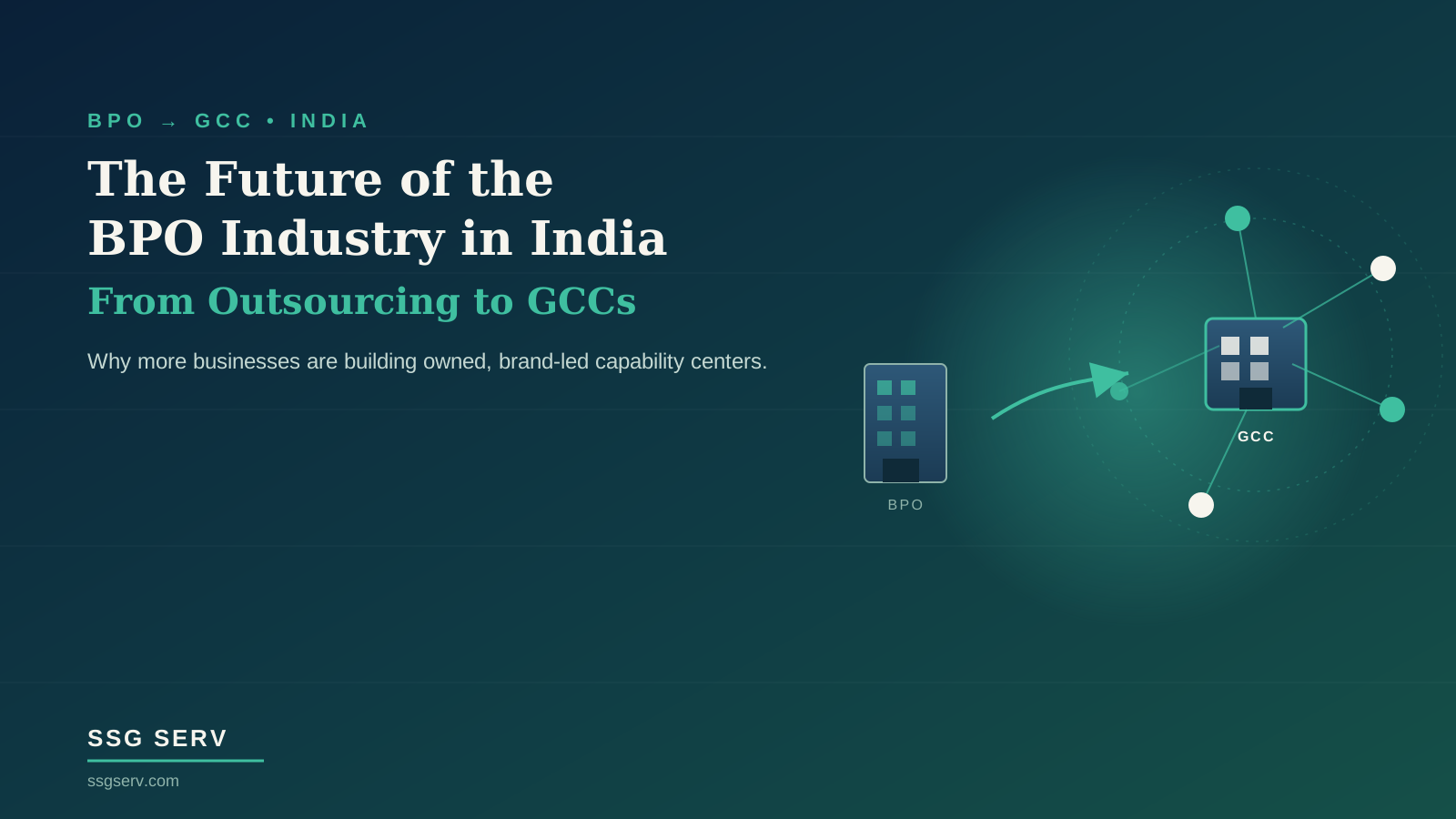
The Future of the BPO Industry in India: From Outsourcing to Global Capability Centers
Outsourcing used to mean one thing: hiring cheaper overseas labour to handle basic, repeatable work. That model hasn't disappeared, but it's no longer where the growth is. Increasingly, companies are building their own dedicated offshore hubs, known as Global Capability Centers or GCCs, to run high-level technology, finance, and innovation work under their own brand and their own control. If you're thinking about expanding operations in India, it's worth understanding why more businesses are moving from a traditional outsourcing company in India toward the GCC model, and what that shift actually changes.
Where the Traditional BPO Model Falls Short
BPOs became a popular option for companies looking to lower operating costs during the 1990s and early 2000s. India became one of the leading global destinations for outsourcing BPO services, from customer support and data entry to IT helpdesk services and other process driven tasks. For many companies, this model reduced operating costs by as much as 40 to 60 percent, and for a long time that was reason enough.
The limitation is that BPOs are built to deliver assigned tasks, not to help with broader business goals. A third party outsourcing company in India is contractually structured around defined outputs and service levels, so it has little incentive or mandate to challenge how a process works or suggest a better one. They typically have limited influence over your organisation's innovation and long-term growth, even though they may handle a substantial share of its day to day operations. Data, tooling, and institutional knowledge also sit with the vendor rather than with you, which becomes a real constraint once the work involved gets more sensitive or more strategic.
What Actually Changes When You Move to a GCC
With a Global Capability Center, you're building a fully owned, dedicated extension of your own company rather than handing work to a shared vendor environment serving multiple clients. That distinction matters more than it sounds. A GCC operates under your brand, follows your governance standards, and gives you direct control over operations, data security, intellectual property, and business processes, in a way a shared BPO arrangement simply cannot.
Today's GCCs also take on responsibilities you won't typically find in a traditional outsourcing engagement. They support end to end business functions, including research and development, finance operations, and digital transformation initiatives. Instead of simply completing operational tasks, GCC teams help solve complex business problems and build new capability for the parent organisation, not just process its transactions.
What Modern GCCs Actually Do
The scope of a mature GCC usually spans several pillars rather than a single function:
- Technology and engineering, including software development, QA, and field engineering support for OEM hardware and equipment.
- Finance and accounting, run by qualified finance professionals covering accounts payable, accounts receivable, FP&A, and audit ready bookkeeping.
- Customer experience and back office operations, delivered under the parent brand with the same governance and escalation paths as an in-house team.
- Research, innovation, and digital transformation work that used to stay onshore, now handled by dedicated offshore teams with direct visibility into company strategy.
India's GCC Growth Story, By the Numbers
India has become one of the fastest growing GCC destinations in the world, and the pace hasn't slowed. The country is home to more than 1,800 GCCs as of 2024, up from a few hundred just over a decade ago, and industry estimates from Nasscom and Zinnov put that figure at somewhere between 2,100 and 2,200 centers by 2030. These centers already employ close to 1.9 million professionals, with that workforce expected to reach between 2.5 and 2.8 million over the next few years. Revenue from India's GCC sector is projected to grow from roughly 65 billion dollars today to somewhere between 99 and 105 billion dollars by 2030.
What's changed isn't just the scale. More than half of India's GCCs have moved beyond cost-driven operational support into portfolio and transformation roles, meaning they now influence product decisions and strategic direction rather than just executing tasks handed down from headquarters.
Why India Remains the Preferred GCC Destination
- A deep, English speaking talent pool across finance, engineering, and technology, with millions of graduates entering the workforce every year.
- Cost advantages that remain meaningful even as the work being done becomes more sophisticated.
- A time zone that supports a follow the sun operating model with US, UK, and European headquarters.
- Mature digital infrastructure and an established ecosystem of GCC operators, vendors, and support services built up over two decades.
Is a GCC Right for Your Business?
A GCC isn't automatically the better choice for every company. It suits businesses with enough sustained offshore workload to justify a dedicated, brand-owned setup, and where control over IP, data, and process is a genuine priority rather than a nice to have. If your offshore needs are smaller, more variable, or concentrated in a single function like customer support, a traditional BPO arrangement, or a hybrid model that starts as outsourcing and evolves into a GCC over time, is often the more practical starting point. The right partner should be able to help you make that call honestly, rather than pushing whichever model suits them.
Partner with a GCC Builder in India
At SSG SERV, we help businesses establish and manage GCC solutions in India that support long-term growth, whether you're starting with a focused outsourcing engagement or building a full-scale capability center from day one.
Contact us online or call +91 9902739635 to learn how we can support your operations.
Faizan Kanth founded SSGSERV with a vision to build a scalable global delivery model, connecting Bangalore, one of India's leading technology hubs, with Srinagar, an emerging center for skilled tech talent. Under his leadership, SSGSERV has grown into a specialized operations partner for global technology companies, serving clients across the United States, the Middle East, the United Kingdom, and the Philippines. With over a decade of experience across leading global technology, automotive, and business process organizations, Faizan brings deep expertise in operations management, business strategy, and market evaluation to every engagement. A postgraduate of a premier Indian management institute, he is driven by an entrepreneurial approach to solving complex operational challenges for enterprises worldwide. Beyond building SSGSERV, Faizan is focused on positioning Kashmir as a hub for Global Capability Centers, having grown the company's Srinagar delivery center to over 500 professionals and counting.