Introduction: The Outsourcing Model Is Broken, Here's What's Replacing It
For decades, enterprise leaders faced a frustrating binary: either build an expensive in-house operations team or hand over critical functions to a traditional BPO vendor and accept the tradeoffs, high turnover, diluted brand identity, rigid SLAs, and a vendor that serves dozens of clients the same way it serves you.
In 2026, that binary is obsolete.
A structural shift is underway across the global operations landscape. The world's most competitive OEMs, SaaS companies, and Fortune-scale enterprises are migrating to a third model: the
Global Capability Center (GCC), a brand-integrated, strategically owned offshore delivery engine that combines the cost advantages of outsourcing with the quality and cultural alignment of an in-house team.
This isn't a trend. It's a permanent realignment of how enterprise operations are structured.
This article breaks down why GCCs are winning, what makes a GCC model genuinely effective, and what enterprise leaders should look for when selecting a GCC partner in 2026.
What Is a Global Capability Center (GCC)?
A Global Capability Center is a dedicated offshore or nearshore delivery center that operates as an integrated extension of your brand, not as a third-party vendor servicing multiple clients from a shared pool.
Unlike traditional BPO models where agents toggle between your brand and ten others, a GCC is purpose-built for your organization's processes, culture, values, and customers. Your GCC team answers calls as your company, follows your escalation paths, uses your tools, and lives inside your quality governance framework.
The GCC model has exploded in popularity because it resolves the core failure mode of outsourcing: the misalignment between vendor incentives and client outcomes.
Key characteristics of a true GCC model:
- Dedicated talent pools, not shared resources
- Brand-integrated training, scripting, and quality assurance
- Direct visibility into performance through real-time KPI dashboards
- Career pathing and employee engagement programs that reduce turnover
- IP ownership and data sovereignty that stays with the client
- Scalable capacity that grows with your business, not your vendor's portfolio
The Numbers Behind the GCC Revolution
The data tells a clear story about where enterprise operations are heading:
- The global GCC market is projected to exceed $110 billion by 2030, with India hosting over 1,700 GCCs employing more than 1.9 million professionals
- Organizations operating GCC models report 40–60% cost reductions
versus equivalent in-house Western headcount, without sacrificing quality - GCC-led customer support operations consistently outperform traditional BPO on NPS,CSAT, and first-contact resolution rates
- Enterprise leaders cite
talent density, operational control, and brand alignment
as the top three reasons for GCC migration, cost is now fourth
The model is no longer a cost play. It's a competitive strategy.
The Five Pillars of a High-Performance GCC
Not all GCCs are created equal. The difference between a mediocre GCC and a high-performance one comes down to five operational pillars that must work in concert.
1. Global Technology & CCaaS
The most sophisticated GCC deployments embed white-label CCaaS (Contact Center as a Service) directly beneath the client's brand. This means customers interact with your brand, not with a vendor's generic interface. Every touchpoint, from IVR to ticket resolution, is brand-native.
Best-in-class GCC technology stacks include:
- 24/7 NOC (Network Operations Center) monitoring with proactive alerting
- L1, L2, and L3 tiered technical support with clear escalation matrices
- Cybersecurity operations integrated with client security posture
- DevOps and QA pods that accelerate product delivery cycles
- ISO 27001-certified governance to maintain data security at enterprise scale
The 30-second SLA for initial response is now considered table stakes for premium GCC providers. Any provider unable to guarantee sub-minute first response across global time zones is operating below the current standard.
2. Data Center & Infrastructure
Enterprise operations depend on infrastructure that never sleeps. A mature GCC model includes data center design, pre-certification auditing, and zero-downtime migration advisory, not just headcount.
The best GCC operators bridge the gap between IT and facilities management, developing SOPs that govern hybrid and cloud topologies and ensuring business continuity even during infrastructure transitions. This capability is especially critical for OEMs and enterprise technology companies whose customers cannot tolerate unplanned downtime.
3. Global Engineering Services
One of the most underutilized capabilities in the GCC model is on-demand engineering talent. Leading GCC providers maintain benches of Mechanical, Electrical, Civil, MEP, and CAD engineers that can be deployed into client projects without the months-long recruitment cycles typical of traditional hiring.
Beyond the bench, best-in-class GCC operators run field engineering networks that provide single-point accountability across multiple continents, particularly valuable for OEMs requiring on-site technical support in markets they don't have local presence in.
4. Finance & Accounting (F&A)
ACCA and CPA-led finance teams operating as a GCC function deliver more than bookkeeping. Modern F&A GCC capabilities include:
- Multi-jurisdiction tax, audit, and compliance management across 30+ countries
- Real-time financial planning and analysis (FP&A)
- Audit-ready reporting for global CFOs
- Regulatory compliance support across EU, US, UK, and APAC frameworks
For CFOs managing global operations, having a dedicated GCC finance team, rather than a shared accounting service, means the team understands your business deeply and continuously rather than reactively.
5. Business Process & Customer Experience (CX)
This is where brand perception is won or lost. Premium GCC providers deliver inbound and outbound CX with:
- 30-second SLA guarantees, not aspirational targets
- 100% transcript QA, every interaction reviewed, not sampled
- COPC and ISO 9001 governance frameworks
- SDR and appointment-setting pods for revenue-generating operations
- Content moderation at scale for platforms requiring compliance-grade oversight
The shift from "call center headcount" to "managed CX as a strategic capability" is what separates GCC-driven customer operations from their BPO predecessors.
The Follow-the-Sun Model: Why 24/7 Support Is No Longer Optional
One of the most operationally significant advantages of a well-structured GCC is the ability to deliver genuine follow-the-sun support coverage, where support operations "follow" daylight hours around the globe, ensuring that no region is served by exhausted overnight staff.
A follow-the-sun GCC model typically anchors on primary delivery hubs in India (covering APAC and EMEA time zones), supported by regional nodes in Europe, the Middle East, the Americas, and Oceania. The result is:
- No geographic gaps in coverage
- No quality degradation during off-peak hours
- Consistent SLAs regardless of when a customer contacts support
- Resilience against regional disruptions through geo-redundant capacity
For enterprise brands with global customer bases, particularly in e-commerce, SaaS, healthcare, and financial services, the follow-the-sun model is no longer a premium offering. It's a baseline operational requirement.
What to Look for in a GCC Partner in 2026
Selecting a GCC partner is one of the most consequential operational decisions an enterprise leader will make. The wrong partner creates the same problems as the worst-case BPO: misaligned culture, high attrition, opaque governance, and brand damage at scale.
Here are the criteria that should anchor your evaluation:
Delivery infrastructure: Does the provider maintain geo-redundant capacity? A single-site GCC is a single point of failure. Look for a primary hub with a verified backup facility and regional nodes that provide true global coverage.
Governance and compliance: ISO 27001, ISO 9001, and COPC certifications are the baseline. Verify that governance frameworks are embedded in daily operations, not just documented in a compliance folder.
SLA transparency: Any GCC provider worth evaluating should be able to give you real-time visibility into their SLA performance, not just monthly reports. Look for live dashboards, not retrospective PDFs.
Talent depth and retention: Ask about attrition rates, career pathing programs, and how the provider measures employee engagement. High-quality GCC operations have below-industry attrition because they invest in the people delivering your brand.
Brand integration methodology: How does the provider embed your brand into their operations? What's the onboarding process for new agents? How is brand compliance enforced in QA? These questions reveal whether a provider truly understands the GCC model or is dressing up BPO with new terminology.
Track record across verticals: A GCC provider that has successfully delivered for OEMs, SaaS companies, healthcare brands, e-commerce operators, and financial services firms has demonstrated the operational flexibility that enterprise-grade engagements require.
Speed to deployment: Leading GCC operators can deploy production-ready teams in 30 days. If a provider's standard timeline runs three to six months, their delivery model isn't optimized for enterprise velocity.
Industry Verticals Where GCC Models Deliver Outsized ROI
While the GCC model creates value across virtually every sector, several verticals are experiencing especially strong migration from traditional outsourcing:
OEM and Hardware Manufacturers require specialized technical support at scale, often across multiple product lines, language requirements, and regulatory jurisdictions. A GCC model allows OEMs to maintain brand-consistent technical support globally without building the infrastructure in every market.
SaaS Companies experience hypergrowth support demand that traditional hiring cycles cannot match. A GCC partner can scale L1 and L2 technical support in weeks, not quarters, while maintaining the product knowledge depth that SaaS customers demand.
E-commerce and Digital Retail Brands require 24/7, 365-day support coverage with zero tolerance for unresolved escalations. The GCC model's follow-the-sun architecture makes this economically viable at scale.
Financial Services and Insurance Firms operating in multiple jurisdictions need support teams with deep compliance knowledge and rigorous QA governance. A GCC's embedded compliance frameworks (versus a BPO's generic ones) provide the audit trail that regulated industries require.
Healthcare and Life Sciences organizations require data sovereignty, HIPAA-awareness, and clinical language competency in their support operations, capabilities that GCC providers with specialized talent benches can deliver more reliably than generalist BPOs.
The ROI Case: How GCC Models Pay for Themselves
The financial case for GCC migration is compelling at every stage of the enterprise lifecycle:
Cost efficiency: GCC operations in India-anchored hubs typically run at 40–60% of equivalent Western in-house costs, covering salary, infrastructure, management overhead, and benefits.
Quality gains: Dedicated GCC teams with brand-specific training consistently outperform shared BPO pools on CSAT, NPS, and first-contact resolution. Every percentage point of CSAT improvement translates directly to retention and revenue.
Operational velocity: GCC models reduce time-to-value on new support capabilities from months to weeks, enabling enterprises to respond faster to product launches, market expansions, and support demand spikes.
Risk mitigation: Geo-redundant GCC infrastructure with documented business continuity plans eliminates single points of failure that expose enterprises to operational and reputational risk.
Strategic optionality: As a GCC team matures, it becomes a genuine capability asset, not just a cost center. Advanced GCC operations take on R&D support, analytics, process improvement, and innovation functions that compound value over time.
SSGSERV: A Decade of GCC Excellence
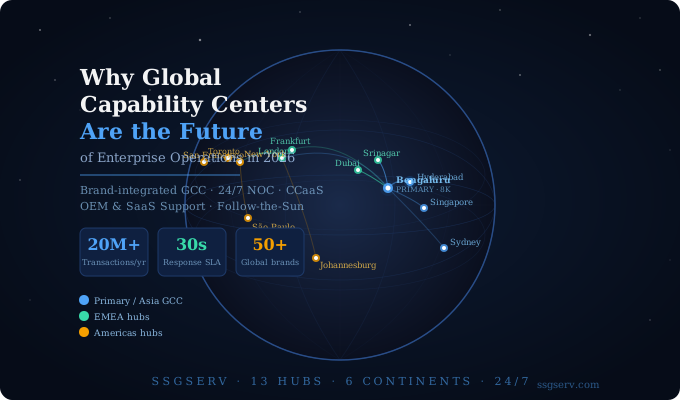
SSGSERV has been delivering Global Capability Center and global support solutions since 2015, serving 50+ brands across six continents with a network that spans 13 delivery sites from Bengaluru to São Paulo, London to Johannesburg.
With an 8,000-seat primary GCC in Bengaluru backed by a 2,000-seat geo-redundant facility in Srinagar, SSGSERV anchors its global delivery network on infrastructure built for enterprise-grade reliability, with a 30-second response SLA guaranteed across all sites.
SSGSERV's five-pillar capability model covers the full spectrum of enterprise operations:
- Global Technology & CCaaS: White-label support, 24/7 NOC, DevOps, QA
- Data Center & Infrastructure: Audit, design, migration, operational SOPs
- Global Engineering Services: On-demand engineers, field coverage, prototyping
- Finance & Accounting: ACCA/CPA-led F&A, compliance, FP&A
- Business Process & CX: Inbound/outbound CX, SDR pods, back-office
With over 20 million annual transactions processed, 1.7 million support hours delivered per year, and ISO 27001-certified governance across all operations, SSGSERV represents what a mature, enterprise-ready GCC partner looks like.
Frequently Asked Questions
What is the difference between a GCC and a BPO? A Business Process Outsourcing (BPO) arrangement places your operations inside a shared vendor environment serving multiple clients. A Global Capability Center is a dedicated delivery structure built exclusively for your brand, embedded with your culture, processes, and governance, operating as an extension of your own organization.
How long does it take to set up a GCC? With an experienced GCC operator, production-ready teams can be deployed in as little as 30 days. Full-scale GCC buildouts, including infrastructure provisioning, talent onboarding, and quality framework implementation, typically complete within 60–90 days.
What is CCaaS and how does it relate to GCC? CCaaS (Contact Center as a Service) refers to cloud-based contact center technology that enables omnichannel customer support. In a GCC context, CCaaS is deployed as a white-label infrastructure embedded under the client's brand, meaning customers experience seamless, brand-native support without knowing an external operator is involved.
How do GCC models handle data security? Best-in-class GCC providers operate with ISO 27001-certified information security management systems, data processing agreements aligned with GDPR and regional equivalents, and network-sovereign infrastructure that prevents unauthorized data access. Always verify certifications and conduct a security audit before engaging a GCC partner.
Is the GCC model suitable for startups or only large enterprises? The GCC model scales from growth-stage companies requiring dedicated support pods to Fortune-scale enterprises running thousands of seats. The key is finding a GCC provider that offers flexible pod structures and pricing models aligned with your stage of growth.
Conclusion: The Window for Competitive Advantage Is Open But Not Indefinitely
The enterprises that migrate to the GCC model now will enter the next competitive cycle with structurally lower costs, higher customer satisfaction, and greater operational flexibility than their peers still running traditional BPO arrangements.
The window for early-mover advantage in GCC adoption is still open but it won't be indefinitely. As more enterprises recognize the structural superiority of the GCC model, the talent market, infrastructure capacity, and implementation expertise will become more competitive.
The question for enterprise leaders in 2026 is not whether to migrate to a GCC model it's how quickly and with which partner.
Ready to explore what a Global Capability Center could look like for your brand? Schedule a consultation with the SSGSERV team and receive a custom 30-day GCC roadmap built around your specific operational requirements.
Faizan Kanth founded SSGSERV with a vision to build a scalable global delivery model, connecting Bangalore, one of India's leading technology hubs, with Srinagar, an emerging center for skilled tech talent. Under his leadership, SSGSERV has grown into a specialized operations partner for global technology companies, serving clients across the United States, the Middle East, the United Kingdom, and the Philippines. With over a decade of experience across leading global technology, automotive, and business process organizations, Faizan brings deep expertise in operations management, business strategy, and market evaluation to every engagement. A postgraduate of a premier Indian management institute, he is driven by an entrepreneurial approach to solving complex operational challenges for enterprises worldwide. Beyond building SSGSERV, Faizan is focused on positioning Kashmir as a hub for Global Capability Centers, having grown the company's Srinagar delivery center to over 500 professionals and counting.